How to get a driving licence after your learner licence
Last reviewed: 12 November 2026
Once you have a learner licence and some practice behind you, the next step is the permanent driving licence (DL). You apply on Sarathi with your learner licence number, book a test slot, pass a practical driving test for each class of vehicle, and the licensing authority issues your licence as a card.
Apply only through Sarathi after selecting your state.
Before you apply: the 30-day rule
Rule 15(1) of the Central Motor Vehicles Rules, 1989 says you cannot appear for the test of competence to drive unless you have held a learner licence for at least 30 days. The learner licence itself lasts six months, so plan your test for some time between day 31 and the end of month six.
Since the Motor Vehicles (Amendment) Act, 2019, you can apply to any licensing authority in your state, not only the one covering your address, and there is no longer a minimum educational qualification for a driving licence.
Classes of vehicle
A driving licence lists each class of vehicle you are allowed to drive. Section 10(2) of the Motor Vehicles Act, 1988 sets out the classes, and Sarathi uses short labels for them:
| Class | Sarathi label | Minimum age |
|---|---|---|
| Motorcycle without gear | MCWOG | 18 (16 if up to 50 cc) |
| Motorcycle with gear | MCWG | 18 |
| Light motor vehicle | LMV | 18 |
| Adapted vehicle | Adapted vehicle | 18 |
| Transport vehicle | Transport | 20 |
| E-rickshaw, e-cart | E-Rickshaw / E-Cart | See Sarathi |
| Road-roller, other specified | Others | See Sarathi |
In 2019 the class formerly called “invalid carriage” was renamed adapted vehicle: a vehicle specially designed or altered for a person with a disability. To take the test for an adapted vehicle you must bring a duly registered adapted vehicle (Rule 15(1A)).
You need a learner licence for each class you will be tested on. If you later want another class, you can add it to your licence.
How to apply on Sarathi
The Sarathi FAQ sets out the route:
- Open Sarathi and select your state.
- Choose Apply online › New Driving Licence and read the instructions.
- Select the option for applicants holding a learner licence, then enter your learner licence number and date of birth.
- Check the details carried over from your learner licence and select the class or classes for the test.
- Upload any documents your state asks for. Files must be JPEG, JPG or PDF, no more than 300 KB.
- Pay the fee on the Fee/Payments page and keep the receipt.
- Book a driving test slot if your state offers online slot booking.
The application can be moved to a different RTO only before the fee is paid. After payment, the Sarathi FAQ asks you to contact the RTO.
Booking the driving test slot
Slots are released by each RTO or state. If Sarathi shows no free slots, the official FAQ advises contacting the RTO, because the portal cannot create slots itself. Where online slot booking is not available, you visit the RTO with your documents to complete the process. Take the slot printout, your learner licence and originals of the documents you uploaded on the test day.
What the driving test checks
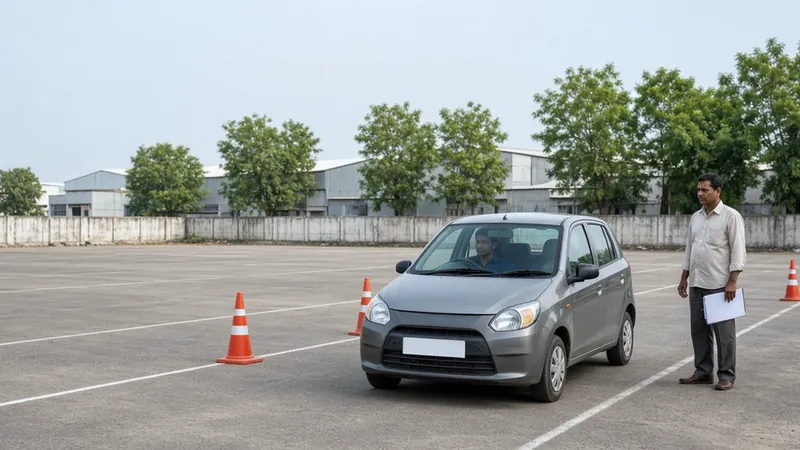
The test is conducted by the licensing authority, or a person authorised by the state, in a vehicle of the class you applied for. You bring the vehicle. Under Rule 15(3), the examiner must be satisfied that you can, among other things:
- adjust the mirrors and take precautions before starting the engine;
- move away safely and smoothly, and change gears up and down as traffic and gradients require;
- stop and restart on a steep upward slope without rolling back, using the hand-brake or throttle and foot-brake;
- turn corners correctly, using the mirror before signalling;
- overtake, be overtaken and change lanes safely with proper signals;
- give clear signals by hand or indicator at the right time;
- stop in an emergency and stop normally at a safe place with signals;
- reverse into a limited opening to the left or right, and turn the vehicle around using forward and reverse gears;
- obey traffic signs, lights and police signals;
- give way to people at pedestrian crossings without signals;
- keep to the left, regulate speed for the conditions, and anticipate pedestrians, cyclists and other drivers.
Some states run the test on a dedicated driving test track; your slot receipt shows the venue. If you fail, you can apply for a repeat test, paying the ₹300 test fee again for that class.
Accredited driver training centres and Form 5B
The Central Motor Vehicles (Eleventh Amendment) Rules, 2021 (G.S.R. 394(E), 7 June 2021) created accredited driver training centres from 1 July 2021. Centres are accredited by the State Transport Authority or an agency notified by the Central Government, and must meet minimum standards, including at least one acre of land for training on two-wheelers, three-wheelers and light motor vehicles (two acres if medium and heavy vehicles are included) and staff qualified to give instruction.
If you complete a course and pass the test at such a centre, you receive a driving certificate in Form 5B. Under the proviso to Rule 15(2), the holder of a Form 5B certificate is exempt from the driving test at the RTO. You still apply on Sarathi, which forwards the centre’s certificate to the RTO for the licence to be issued. Ask your RTO or state transport website for the list of accredited centres near you, since ordinary driving schools do not issue Form 5B.
What to carry on test day
Sarathi and your RTO may list extra items, but plan to bring:
- the slot booking receipt and the fee receipt;
- your learner licence, printed or on your phone;
- the originals of the proof of age and address you uploaded;
- a roadworthy vehicle of the class you are being tested on, with its RC, valid insurance and pollution under control certificate, and the L plates fitted;
- for a transport class, the medical certificate in Form 1A.
If you bring a borrowed vehicle, carry the owner’s documents for it.
If your application seems stuck
The Sarathi FAQ covers the usual hold-ups:
- Pending at scrutiny for days. Visit the RTO on the appointment date with your documents to complete the remaining steps. Where online slots are not offered, go to the RTO with the documents as soon as you can.
- Payment pending. The application cannot move until the payment shows success or failure. Check with your bank, or clear the payment at the RTO. If no money was deducted, you can cancel the application and apply again.
- Lost the application number. Use Apply online › Search related application numbers with your learner licence number.
- Approved but not delivered. Ask the RTO for the dispatch tracking number.
Foreign licence holders and defence personnel
The Sarathi FAQ says holders of a foreign driving licence and defence personnel apply through the same Apply online › New Driving Licence route, choosing the option that fits them before submitting. The RTO then decides which tests, if any, are needed for your case.
Fees for a driving licence
Rule 32 of the Central Motor Vehicles Rules sets the central fees:
| Item | Central fee |
|---|---|
| Driving test, per class | ₹300 |
| Issue of driving licence | ₹200 |
| Laminated or smart card | ₹200 |
| One class, total | ₹700 |
| Two classes, total | ₹1,000 |
| Repeat test, per class | ₹300 |
The note to Rule 32 says the learner licence fee, the learner test fee and the driving test fee are paid together at the stages where they apply. States may charge lower fees or add charges for automation, technology and testing, so Sarathi’s payment page is the final figure. The fee calculator shows the central amount for any combination.
How long a driving licence is valid
Section 14(2) of the Motor Vehicles Act, as substituted from 1 September 2019, links the validity of a non-transport licence to your age on the date of issue or renewal:
| Your age at issue or renewal | Valid until |
|---|---|
| Under 30 | Your 40th birthday |
| 30 to under 50 | 10 years |
| 50 to under 55 | Your 60th birthday |
| 55 and above | 5 years |
| Transport vehicle | 5 years |
| Hazardous goods | 3 years |
Since 15 August 2026, under the Jan Vishwas (Amendment of Provisions) Act, 2026, every driving licence continues to be effective for 30 days after its expiry date.
A licence for an e-rickshaw or e-cart is valid for not more than three years, or until the validity of the driving licence, whichever is earlier (Rule 16(6)). When the time comes, see driving licence renewal.
The licence card, DigiLocker and mParivahan
Rule 16 says every driving licence is issued or renewed as a laminated card without chip or a smart card in Form 7. Most states post it to the address in your application. If the licence is approved but not delivered, the Sarathi FAQ asks you to get the dispatch tracking number from the RTO.
A digital copy can be shown through the Nexgen mParivahan app or DigiLocker. If your licence is missing from DigiLocker, the RTO first has to migrate the record to Sarathi.
Adding another class later
To add a class, for example a car to a motorcycle licence, you first get a learner licence for the new class. Then on Sarathi go to Services on Driving Licence and choose the additional endorsement. You will need your valid driving licence, the valid learner licence, the self-declaration of fitness (or Form 1A for a transport vehicle), and the fees: ₹500 for the addition plus ₹300 for the test, and ₹200 if a new card is issued.
Proposed changes in the 2026 draft
MoRTH’s draft G.S.R. 902(E) of 16 October 2026 proposes, among other things, revised proof-of-identity lists, laminated or PVC cards in a new design for Indian and foreign nationals, and the option to surrender a class of vehicle online. Nothing in the draft is in force until final rules are notified.
Frequently asked questions
How soon after the learner licence can I take the driving test?
After at least 30 days, and before the learner licence expires at six months.
Can I take the test in a different RTO?
Since 2019 you can apply to any licensing authority in your state. You can change the RTO on an application only before paying the fee.
Do I need to take the RTO test if I trained at a driving school?
Only a Form 5B certificate from an accredited driver training centre exempts you. A certificate from an ordinary driving school does not.
What is the total fee for a car driving licence?
The central fee is ₹300 for the test, ₹200 for the licence and ₹200 for the card, ₹700 in all, plus the earlier learner licence fees and any state charges.
What happens if I fail the driving test?
Section 9(5) of the Act does not allow a repeat test until seven days after the last one, and since the 2019 amendment it also requires the applicant to complete a remedial driver training course from a licensed driving school or establishment before the retest. You pay the ₹300 test fee again for each class you retake.
Can I use a car with automatic transmission for the test?
The test is taken in a vehicle of the class you applied for, which for a car is the light motor vehicle class. Ask your RTO whether any restriction will be noted on the licence for a test in an automatic.
Do I need to submit Form 1A for a car licence?
Not normally. A self-declaration of fitness is enough for non-transport classes. Form 1A, the medical certificate, is for transport vehicles, and for renewals once you are 40 or older.
Is my driving licence valid across India?
Yes. A driving licence issued under the Act is effective throughout India.
Can I drive on a learner licence after failing the test?
Yes, within the learner licence’s six-month validity and its conditions, until you pass a repeat test.
Also see: learner licence, driving licence renewal, international driving permit, forms and fees.